Capitalism, as we are told, is the best principle of economic system as it drives all those in charge of production (the owners and top executives of enterprises) to maximize profits at minimal costs and thus earn economic efficiency (Capitalists get profits, and the rest of us benefit from the efficiency of production within a capitalist system). But, the ongoing global crisis caused by the COVID-19 pandemic has raised fundamental questions against the current world order, dominated by neoliberal capitalist ideologies. Thus making us rethink whether Mar was right when he had quoted “The last capitalist we hang shall be the one who sold us the rope”.
The self-destructive nature of capitalism in the recent times occurs in the following ways:
Rising income inequality
Accordingly, India’s richest 1% carries four times more wealth than the combined wealth of the bottom 70%. Internationally, the report says 2,153 billionaires have more wealth than 60% of the global population. Ironically, in the COVID-19 pandemic also, the same wealthy corporations are once again on the forefront seeking massive bailouts.
Automation of Jobs
Displacement of workers by machinery is the formula for the self-destruction of capitalism. In the 20th century, it was expected this would happen because mechanization would virtually eliminate the manual labor force. This did not happen, because of the rise of a middle class of administrative and communicative labor. But now computerization and the electronic media are eliminating the middle class. This is happening much faster than the mechanization of factory work. It took 150 years to eliminate most of the working class, while we are on a pace to eliminate most middle-class work within 50 years from the takeoff of information technology in the 1990s.
There is a great concern in the growing gap between education and employment thus making the automation of jobs very adverse in impact. When automation happens, the argument by capitalists are that more specialized and more technical-oriented white collar jobs would be replacing the displaced ones. But clearly there is a gap between the skills imparted by the education system and the employment requirements. Statistics show that Indian universities produce millions of graduates every year, but only about 20% of them are absorbed into various industries. An unemployable workforce is at the core of India’s employment crisis.
Environmental Damage
It doesn’t end here. Four decades of neoliberal economics has also unleashed an environmental havoc. With temperatures soaring, ice caps melting and greenhouse gas emissions (GHGs) rising, climate change is no longer a distant reality. Many believe that the destruction of prime natural resources, forests and biodiversity hotspots has led to the emergence of deadly diseases. A complex web of relationship exists between industrial farming, factory farms and bushmeat markets calling for an immediate fixing of the broken food systems so as to avoid the next pandemic. Whether it is the resulting environment destruction or the rampaging economic inequalities, the COVID crisis should act as an urgent wake-up call for governments to move towards an economic system where the majority population is not deprived of basic necessities, where the emphasis shifts from economic growth to the economics of well-being.
The recently announced EIA bill by Indian Government just raises more concerns in the same aspect.
Marx threw light on the basic character of the capitalist mode of production where the output of social labour was appropriated for private profit. This intrinsic nature of capital would lead to inevitable contradictions within society. The more capitalism grows, the more this contradiction too will grow.
Maybe it’s high time that we have a new socio-economic order.
The first official post of ‘The Great Illusions’ :-The Illusions of Economics
According to published figures, India is world’s Third-largest producer of refined oil after China and US, but for meeting the oil needs, India imports more than 80% of total oil needed. Therefore, India’s economy is highly dependent on price of oil as it mainly relies on its import. Economists believe that an increase of $10/barrel in crude oil prices can raise inflation by 10 basis points (0.1%). The following blog discusses about the relationship between oil price and inflation and the factors which makes this a macroeconomic problems and those policies that can be adopted to solve this issue.
Introduction
Crude oil is a
liquid fuel source located underground. It is extracted through drilling. Oil
is used for transportation, petroleum products, and plastics. Its constituents
are 50 to 97% hydrocarbons, from 6 to 10% is nitrogen, oxygen and sulfur and
less than 1% is metals like copper, nickel and iron. Oil
is an important input in the production of a wide range of goods and services,
because it is used for transportation in business of all types. Higher oil
prices will increase the input costs resulting the final product price
increasing causing inflation in the economy, if the cost increases cannot be
passed on to consumers, economic inputs such as labor and capital stock may be
reallocated. Higher oil prices can cause worker layoffs and the idling of
plants, reducing economic output in the short term. In a net importer of oil
economy like India, higher oil prices shrink foreign reserves of the economy,
affect the purchasing power of the economy in terms of International trade. The
increased price of imported oil forces the businesses to devote more of their
production to exports, as opposed to satisfying domestic demand for goods and
services, therefore cause inflation, even if there is no change in the quantity
of foreign oil consumed petroleum.
In India, with the
rise in price of crude oil there will be following consequences-
Adverse impact on fiscal
deficit
India imports more than 80% of oil
requirement from abroad. If the price of oil increases in the foreign market,
India will have a toll over its revenue and spending leading to fiscal deficit.
In order to meet this, the government has to resort to increase in taxes which
will result in fall of disposable income of the common people.
Fall in the value of rupee
As per live-mint reports, the value of Indian
rupee is at Rs68.45 to US dollar and is expected to depreciate more if the price
of oil rises in the global market. In order t prevent this, the RBI has to take
the necessary steps.
Affects Current Account
Deficit (CAD)
CAD is a measure of India’s trade where
the value of goods and services imported exceeds the value of goods and
services exported. CAD essentially indicates how much India owes the world in
foreign currency. CAD to GDP rose from 1.9% to 2.3% showing already how much
India owes foreign countries. With rise in price of oil, it will further
increase our CAD.
Impact on share values, Sensex
and midcaps
A lot of Indian companies depend on
healthy crude oil prices. This includes tyre, lubricants, and footwear,
refining and airline companies. The profitability of these companies is
adversely affected due to higher input costs. This could negatively impact
stock prices in the near term. On the other hand, oil exploration companies in
the country could benefit from a rise in oil prices.
Rise in inflation
Inflation is a quantitative measure of rate at which the average price level of a certain selected goods and services in an economy rises over a period of time. It basically, indicates decrease in nation’s purchasing power. The most commonly measurement used by the countries for measuring inflation is Consumer Price Index (CPI). CPI is calculated by taking price changes for each item in the predetermined basket of goods and averaging them based on their relative weight in the whole basket. As a coin having two sides, inflation also has negative as well as positive effects on the economy. Increase in price of oil affects 96% of transportation in India, which results in increase in prices of goods and services and thus the real wages goes down, because when cost of production increases cost of living also gets affected. If the inflation is more than the desired level of inflation then then it’s not good for the economy, it leads to-
Higher cost of
borrowing
Reduces
purchasing power
Increases
unemployment
Lower exports
Government will
have to increase taxes
History of oil prices and pricing in India.
‘Determinants of Crude Oil Prices in India’by Narendra Punati, Raghavender Raju. G (2017)
Crude oil started
gaining importance during World War II and the price-deciding body was Texas
railroad commission from US. From 1948 to 1960, oil price remained around 2 to
3 dollars per barrel. By 1971, the power shifted to the hands of OPEC
(Organization of Petroleum Exporting Countries). The body was mainly taken over
by UAE, Qatar, Indonesia, Libya and Nigeria. The power of controlling oil
prices was in their hands. India’s GDP growth also jumped to 4.6%. There were
fluctuations in prices first in 1972, followed by 1980s due to crisis in Iran
and Iraq. In 1997, due to Gulf-war, invasion of Kuwait by Iraq, the prices
fell. At the same time around, India’s GDP fell from 8% to 5.5%. To meet Asian
countries growing needs, OPEC increased the production quotas. Hence, the
prices rose.
There was a fall later in 1998 due to South-East Asian crisis, making India’s GDP growth rate to be around 4%.Later, with due course of time GDP rate reached 9.3%. That downward push was later again spiralled by 9/11 attacks in the US. The price started increasing gradually till the recession hit in the year 2008. It took over 18 months to recover. During this time, GDP was recorded at 6.9%. Due to Asian giant markets like China and India, OPEC recovered. From 2010, the prices has remained soaring high.
Detailed
Analysis of Oil Prices and Inflation Rates from 2008-2018.
Objectives of the study
To analyze the behavior of
change in oil price and average inflation rates for a period of 10 years.
To show the deteriorating
positive relationship which used to be strong during 1960s when along with the
oil price, inflation also used to rise.
Entry of new factors started
altering the relationship between this two macroeconomic variables.
Limitations of the study
The petroleum prices that have
been taken is of Chennai city. Based on the cities there will be a change in
price of petroleum.
Both petroleum prices and
inflation rate is taken average of the whole year. Not a point representative
value.
Other variable factors
remaining constant.
Results of the study
Using the data collected from various
sources we have organized both the quantity variables measured in their
respective units shown in Table 1. Now let’s compare the incremental changes in
both the variables throughout 10 years. There was a notion that there used to
exist a strong positive relationship between oil price and inflation from
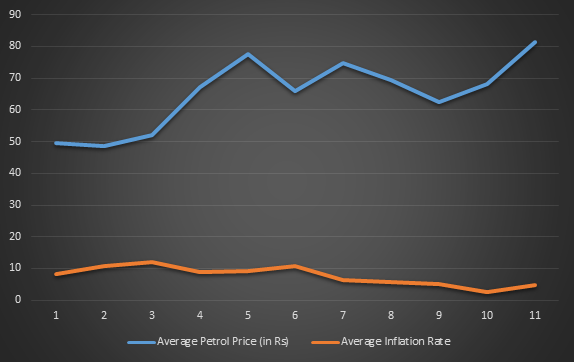
1960s. We can observe from the pattern from Graph 1.
Table 1-
Representing petrol prices and inflation rates (2008-2018)
Years
Average Petrol Price (in Rs)
Average Inflation Rate
2008
49.64
8.32
2009
48.58
10.83
2010
52.13
12.11
2011
67.22
8.87
2012
77.53
9.3
2013
65.9
10.92
2014
74.71
6.37
2015
69.45
5.88
2016
62.47
4.97
2017
68.26
2.49
2018
81.43
4.81
The following
inferences can be observed from the data-
If you observe, we can notice
that even with huge changes in petrol price, there is a less change in
inflation rates throughout the period.
In 2010, when oil price crossed Rs50 for the
first time, the inflation rate hit the maximum of all time that is 12.11.
In 2012, when oil price rose to record breaking
Rs77.53 (Highest in history of India till 2018), the inflation rate recorded a
high figure of 9.3. But when the oil price fell to Rs64.9 next year, inflation
rate still went up to 10.92.
In subsequent years, inflation rate had a
direct relationship with change in oil price from 2013 to 2017. Both started
falling. Oil price fell from Rs74.71 to Rs62.47 and inflation from 6.37 to 4.97
in 2016. From 2013 onwards, the economy became stabilised and inflation rate
was less and perfect as the crude oil price was steady and being controlled by
the Government.
In 2017, the inflation rate still kept falling
and reached the lowest that is 2.49 but the oil price rose from R62 to Rs68.26.
The reason it didn’t much affect inflation was as the price of oil was expected
and controlled by the Government thus protecting the economy from
over-inflation.
In 2018, due to tensions between Middle East
countries like Saudi and Iran and other South American country Venezuela
affected the oil price in India. Because of all this geopolitical issues, the
oil price reached the highest price in Indian history as Rs81.43. The marginal
increment from last year price was around Rs13 which was also the highest till
date.
From 2018, the government
stopped subsidizing oil prices, leading to abundant increase in petroleum
prices in the country, but inflation was controlled showing the failure of
positive relationship between oil price and inflation.
Conclusion
and Policy Suggestions
From the study, we can observe that the
relationship between oil price and inflation is not that strong compared to
that of they had in 1970s. The dependence of inflation on oil price is
weakening. We can also see that only if the government is regulating oil
prices, there is a pattern in both the variables.
India’s import dependency on petroleum rose to 81% in 2015-16 from 78.5% in the previous year. Just last year, PM Narendra Modi had set a target of bringing this down to 67% by 2022. The government is now trying to correct the old blocks like limited participation of resource-rich foreign oil companies and inefficiency of domestic output, etc. by new exploration policies. Due to our increasing import requirements, leads to higher oil prices, leading to more fiscal deficit, whereas have to impose subsidy for the general public too. Thus, to meet the growing demand for crude oil, diesel and petrol etc. in the long run, India have taken various measures such as market linked relative prices and minimizing subsidies. The main thing the government should focus on is targeting the sections who actually needs the subsidy. It also needs to enhance petroleum supplies through increased domestic explorations as well as other measures, such as participation in exploration and production in foreign oil fields by Indian oil companies which the Chinese are using extensively, to avoid excessive dependence on imported crude oil. India also needs to more vigorously pursue the use of renewable energy sources like hydro, wind, solar, bio-fuels, nuclear, etc., as the Western European countries have done. Careful planning to ensure that future petroleum requirements can be met will be crucial in sustaining rapid economic growth in the future. There should be a separate reserve kept to meet sudden surges or fluctuations in oil price, by not putting the pressure on consumers.
 The great illusions